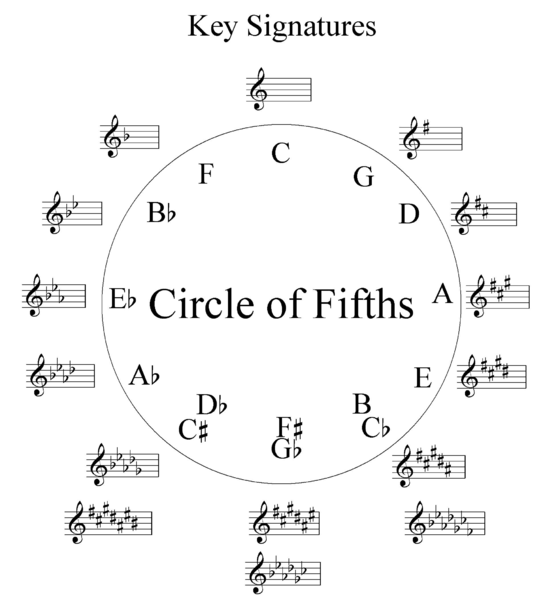
When I was just beginning to learn music theory for guitar, I asked my guitar instructor, Matt Wade (who would be puzzled to see his name come up here) "when you play a solo, are you thinking about the chords or the scale?"
He said "well, chords and scales are pretty much the same thing to me."
It was one of those moments where I didn't really get what he was saying, but I knew enough to know I needed to learn this principle. Having learned it, I think it has application to the Christian life.
In Western music (with apologies to all you Byzantine Chant nerds), everything relates back to the major scale. If you want to make a major triad, you simply take the first, third, and fifth notes of the major scale. The third is, in this context, called a "major third" in that it is two full steps from the root (the "root" is the first note of the scale). If you want to make a minor triad, then you flat the third. "Flat in relation to what?" Well, the major scale intervals. Instead of two full steps from the root, you get a step and a half, and we call that a "flat third" or "minor third."
There are, of course, other ways to look at it. You can say you are taking the first, third and fifth of the minor scale, but the minor scale is also in relation to the major scale. Say in the key of C, you have the root (C), flat third (Eb instead of E), and fifth (G) to make a C minor chord. For the entire natural minor scale, you also flat the 6th and 7th. "Flat in relation to what?" Well, the major 6th and major 7th.
Somewhat of a similar concept, also in relation to the major scale, a 7th chord (or "dominant chord") is a major triad with a flat 7th added (so four notes). "Flat in relation to what?" Well, the major 7th. Etc.
It doesn't matter what scale or chord you are talking about, it always relates back to the major scale. So when my guitar instructor said "chords and scales are pretty much the same thing," what he meant was both chords and scales are just ways of arranging the notes in the major scale, either augmenting them or diminishing them ("sharping" or "flatting" in this sense) to color the music you are playing. A different scale is not a different thing. It's a different application of the same thing. There is no natural minor scale, or major or minor pentatonic scale, or harmonic minor scale, or whatever, without relation to the major scale. It all begins and ends there. Every chord and every scale has a relation back to the intervals of the major scale.
The Christian life is very much like this. We tend to want to separate aspects of Christian living. There is the monastic life. The married life. Parish life. The episcopacy. The priesthood. These, as we like to view them, are all different things. "I'm a father, but not a priest." "I'm a monastic, so I am not in the world." But all of them ultimately relate back to the one life in Christ. He is the uniting principle in Christianity. In that sense, there is no "ultimate" expression of Christianity. There is no Church of one, other than the One Who is Christ. We are all members of the Church not of our own accord, nor in some sort of fragmented way, but in relation to Him. The married life seeks to glorify Christ by the union of the two people in the marriage. The priesthood seeks to glorify Christ by carrying out His ministry. The monastic life seeks to glorify Christ in prayer for the world, to and through Him Who redeemed the world. It's not different things, nor even a hierarchy of good things, but rather it's all different ways of expressing the same thing.
Monasticism is a later development in the Church. It is a perfectly Christian practice, and it is good, but we tend to want to make it the ideal. In a sense, it is the fullest expression of the Christian faith, because the monk or nun devotes his or her life to the things of God, doing all the services, saying all the prayers, working to adorn the grounds and one's cell, and being fully immersed in the Church. But in a proper sense, it is simply a different expression of the same thing. Are you less of a Christian because you stay away from liturgy to help an elderly parent or someone who is infirm, hungry or homeless? Are you less of a Christian because you cannot be in the church building every waking hour because you have to work and provide for your spouse and children? Are you less of a Christian because you cut the grass in your home and not on the church grounds? Of course not! The opposite is also true. Being "in the world" is not superior to monasticism, it's just different. All of our labors are needed. Because all of our labors point back to Christ.
Are you single and celibate? Fantastic! St. Paul famously extols your virtue! Are you married! Also fantastic! St. Paul celebrates you as well! Bishops are to be "husbands of one wife," but that does not, obviously, mean our bishops are transgressing because they are celibate and monastic. The Church, in her good order, determined that a bishop should be devoted to the Church and not have his loyalties divided by maintaining a family. Unlike the Catholics, our priests are not so bound, and are free to marry and have children. None of these is bad, and none of these is lesser than the others.
It is the same with service in the Church. I am a reader. I am not "in charge." I am not the boss. I have responsibilities, and I try to do those to the best of my ability. But while it is a great honor to serve the Church, it is not a point of pride nor anything to boast about. I am the lowliest servant. My priest is the head servant in our parish. He submits to the bishop, who is the chief servant in our diocese. But the bishop is not more saved than I am, or my priest is, either because he is a bishop or because he is a monk. We're all in this together. The uniting principle is not office or service, but Christ. The Church's order exists not to exalt one above another, but so that the Church can fulfill this one ministry of Christ effectively and in good order.
If your membership and participation in the Church does not relate back to Christ, then you are making sour music. If it does, then there is no need to bifurcate your vocation, membership, and service in comparison, much less opposition, to another's. The monk's service and salvation are in relation to Christ, as is my own, and as is yours. The Church is truly One in Him.

