Wednesday, June 10, 2026

Don't Be a Weirdo/Touch Grass


One of the best pieces of advice I got early on as a would-be Orthodox Christian was "don't be a weirdo."  I forgot who wrote it -- it was on one of the blogs I frequented back in those days (2010-ish).  But it was instructive.  As the kids say these days, it was an imperative to "touch grass."

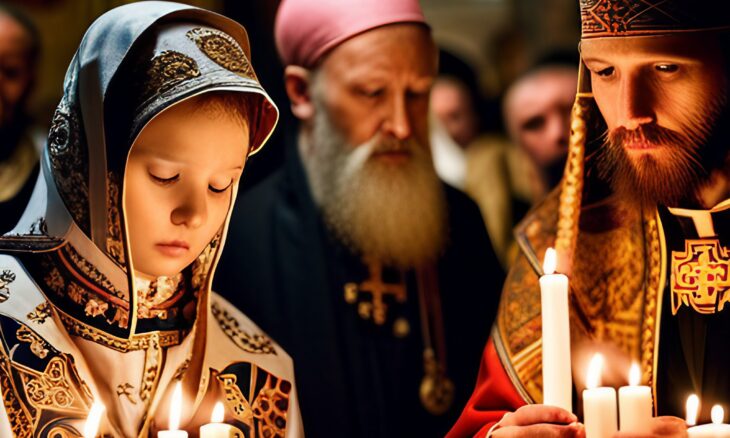
Both of these sayings lead to the same place.  The Orthodox Church is already weird by American Christian standards.  Since 2012 I have been blessed to wear the cassock as a reader.  So I dress like the picture above for Church every Sunday (I'm the one reading the Epistle and, well, wearing the cassock).  There isn't much need to be any weirder than that.

As I wrote a while back, there is a tendency among a handful of folks to put on Orthodoxy like a costume.  Orthodox LARPing as it were.  There is a healthy expression of this, in that the outward things of the Church -- crosses, prayer ropes, head coverings, etc. -- are all good things.  The misuse of a thing does not negate its proper use.  But it is in fact a misuse of these things to treat them as accessories.  As I wrote then, wear your prayer rope, but use it.

But more than that, the potential for misuse goes way up when we forget that the outward things are connected to spiritual things. It does little good to dress up in Orthodoxy and then fail to live it out.  We fail to live it out both when we reject our neighbor and when we scare him off from the Church because we are so bizarre that he figures our parish must be as well.  

We are fortunate at St. Patrick to have a community of real people, with real lives, who live out the Christian faith within their normal lives.  That is, we don't gather a lot of weirdos, at least not any weirder than you'll find in any other place in the country.  Our priest is pretty normal.  His wife (also pictured above) is pretty normal.  Our people, as you can see above, are pretty normal.  We are neither monastic fetishists nor ethnic and cultural appropriators.  We aren't trying to remake Holy Rus in this little storefront church.  We have actual Russian people who attend our parish, so our nods to the old country are authentic, not pretentious. Then again, our Russian friends are from the present, so that's what you'd expect.

I don't say all this to come down on those who are new to the faith and still discovering all the shiny new exotic toys the Russian, Greek and Arabic worlds have to offer through our parishes. Our food would be poorer if we didn't absorb some of that (then again, theirs would be too if not for our fried chicken and banana pudding).  I don't mean to criticize those who are serious about maintaining a prayer rule or are diligent about reading about the faith.  Those are all good things.  But remember to get out and touch grass.  Orthodoxy is lived right where we are.  I tell our catechumens frequently, "salvation starts right now -- God isn't waiting for you to die."  That's the Orthodox faith.  We take it into the world, and in so doing transform the world.  That is not bound up in monastic and cultural trappings.  It happens wherever you may be.  Bloom where you're planted.

It is notable that there would be no Russian Orthodox culture if St. Vladimir hadn't Christianized Russia. The Arabic and Greek-speaking worlds were Christianized early on, as was the Latin world, but the Russian Church is evidence that Orthodoxy takes the culture as it is and transforms it into itself.  The reason OCA and ROCOR parishes look and sound different than Greek and Antiochian parishes is the Russians took their own music, culture, tradition, and piety and made the faith their own.  Not by changing the faith, but by being authentically Russian in their practice of the Orthodox faith.  You only need to note the four-part harmony in any Russian-descendent parish to understand this.

We are called to do the same here. Which is not to say we should eradicate Russian (or Greek, or Arabic) language or music from our liturgies, or stop enjoying their food or venerating their saints.  The Church is One, for sure, and our forefathers have left us a blessed and beautiful inheritance.  I absolutely adore Russian chant and Byzantine chant alike.  But the Church is also not bound up in a previous time, when it was supposedly "more authentic" or "purer."  The Church is for our time just as much as the high water mark of the Byzantine Empire or the full glory of Holy Rus.  We aren't called to recover those moments in the past.  We are called to recreate them right where we are, in a way that works in our culture and our country and among our people today.  We can no more recreate the 7th century Hagia Sophia than we can recreate 1st Century Palestine.  We live in the 21st Century.  The Church is relevant here and now.

So yes, please, more Obikhod chant and Kievan chant.  More Pascha cheese and chotkis.  We love that stuff too.  Just don't forget the burgers and dogs, and don't make it weird.

Wednesday, June 3, 2026

Spiritual Fatherhood


I wrote approximately six months ago about our then-new priest, our father in Christ, Fr. Seth.  Fatherhood is an important part of the priesthood, and the Church in general.  As I wrote in that post, fathers are the glue that holds a family together, and we thank God for ours.

There is also, however, a more pointed definition of "spiritual fatherhood," and I fear it is often misunderstood.  Part of this is simply that the various Archdioceses are not consistent in how they discuss it, and sometimes, even within an Archdiocese there are discrepancies.  There are, however, some commonalities, and I thought it worth discussing the notion and how it plays out in Orthodox parishes.

First, the notion of a "spiritual father" comes from the monastic life, not the parish.  In that sense, a young monk is often assigned to a wise, experienced elder to assist him in the monastic walk.  Eventually, the practice of private confession expanded beyond restoration of lapsed heretics and monastic life to the parish, and the notion of "spiritual fatherhood" in the parishes developed. It is the same principle, but not the same application.

His Eminence, Metropolitan Saba, wrote a few years ago that:

The Orthodox tradition does not recognize the phrase “spiritual father.” This is a modern term that appeared in Western languages, possibly influenced by Catholic spirituality. The Orthodox tradition uses the term “elder,” which corresponds to geronda in Greek and starets in Russian. This term embodies the Orthodox understanding of what is now commonly called a “spiritual father.” One who has grown old in his life with God and has come to know it through personal, living experience is called an elder (geronda). This means that he has spent time as a disciple in the spiritual life and has advanced in it to the point of becoming a great expert, capable—through the testimony of recognized and holy fathers—and guiding others in it. Likewise, the Orthodox tradition does not recognize an academic method that one follows to obtain the role of a spiritual father. The only path is discipleship under an experienced elder for growth in what we call “the life in Christ.” The gift of serving as an elder comes from God, not from studying theology academically or only holding the priestly office.

On the other hand, the Orthodox Church in America's clergy guidelines say that:

The priest is the spiritual father of his parish, and every parishioner ought to respect him as such. 

So you can see, there is some overlap, and also a little confusion, about what is being discussed.  For example, Metropolitan Saba indicates a "spiritual father" is to be an elder, someone who has grown old in his life with God and has personal, living experience in the spiritual life.  And yet, the OCA says every priest is a "spiritual father" in his parish, even though many priests are sent to their parishes straight out of seminary, in their 30s.  What gives?

I would suggest that Metropolitan Saba and the OCA's clergy guidelines are using the same words to describe different things.  His Eminence is discussing the idea of a "spiritual father" as equivalent to an elder in a monastery, someone who will guide you through your spiritual walk and assist you in things of the faith.  The OCA is stating the reality that, as I wrote in my earlier blog post, the priest is in charge of his parish, and is responsible for the faithful there, but not suggesting that every priest is a monastic abbot who ought to be neck deep in the personal lives of his faithful.  We can see this by the fact that Metropolitan Saba makes clear that what he calls a "spiritual father" is really, in the Church's Tradition, more properly called an "elder."  That is, he is using that term exclusively to refer to the sort of elder-novice dynamic you find in the monastic life.  This is further discerned by evaluating the rest of His Eminence's encyclical, particularly where he draws a distinction between a "confessor" and a "spiritual father":

A confessor, on the other hand, holds a significant position in the Church as institution. He is a canonically ordained priest whom his bishop deems qualified to hear confessions, offering guidance from the Holy Gospel and the teachings of the Church Fathers to help believers walk their Christian path in a way that pleases the Lord. If the elder is a priest, he may fulfill both roles, serving as a confessor while providing spiritual fatherhood. The faithful, as guardians of true faith, discern who possesses the gift of spiritual fatherhood based on the fruits of his guidance over time. 

So as Metropolitan Saba understands, there is a difference between "spiritual father/elder" and "parish priest/father confessor," though the two can rarely be embodied in the same person.  His Eminence goes on to say:

St. Basil the Great describes the spiritual father as “the physician of souls who heals with great tenderness according to the teachings of Christ.” He also calls him the “healer of the passions” (Letter 45:5-6). A true elder is a spiritual doctor who heals the soul from its diseases and struggles, liberating the person from the bondage of sinful passions. He focuses on the inner transformation of a person rather than external behaviors. The elder, through the guidance of the Holy Spirit, creates a new person in Christ, not the other way around. One of the greatest qualities of an elder is the gift of discernment. Spiritual guidance requires deep understanding of the human soul, its struggles, and the ways in which the devil tempts people. A confessor who lacks this discernment may offer wrong spiritual advice which can harm rather than heal. Metropolitan Athanasios of Limassol, a disciple of St. Paisios the Athonite, states: “Bad spiritual advice is like giving the wrong medicine to a sick person.” He warns that if an elder lacks discernment, he can misguide his spiritual children away from salvation. In one of his talks to nuns, he advised: “You must learn how God works in the hearts of people so that you do not give advice that could harm them” (Gifts of the Desert, Chapter 8). 

It is this last part that I think distinguishes true spiritual fatherhood from either a father confessor or, worse, what the Slavic Tradition refers to as a "mladostarchestvo" or "young elder." It is notable that what the word "starets" in the Slavic Tradition implies, the word "geronda" in the Greek Tradition makes plain.  "Geronda" means "old man."  One who lacks experience, training, and years of discernment is not an elder, no matter how much he might wish to be.  He can be a father confessor, a priest, a good person, a solid Christian. But he is not an elder.  If he attempts to act as one, he is likely to give sick parishioners the wrong medicine.  That is bad enough when it is a confessor giving imprudent penances or too-strict prayer and fasting rules.  It is positively destructive when it gets into marital advice, psychological counseling, financial guidance, or other things the priest has no business concerning himself with.  A former priest is an actual psychological counselor, and he told me on more than one occasion he tries to never mix the two disciplines.  That is wise.  

More, a "spiritual father" or "father confessor" (whichever applies) is there to guide you in spiritual matters. It is one thing for your priest to advise you on a prayer rule, or fasting.  Even if he does so poorly, the damage is rarely so bad it cannot be contained.  But you don't need a blessing to decide what color refrigerator to buy or who your friends can be.  A parish priest who thinks he can effectively guide you in financial matters or tell you who you are allowed to date is probably not a "spiritual father" so much as a narcissist and control freak.  There may be exceptions to this -- Metropolitan Saba wisely notes that a "spiritual father" is discerned by the fruits of his guidance.  But note well -- he also said this discernement is made by "the faithful, as guardians of the true faith . . . ."  It is not made by the priest himself.  No priest can impose on you such a relationship of power and control. You must submit to it voluntarily.  Do so with extreme caution outside a monastic setting.  The good priests will tell you the same.  I've met many good priests who are wise and capable, but not one who is clairvoyant.  The vast majority of monks aren't either.  We aren't enthusiasts nor charismatics.  Spiritual gifts are many and abundant, but everyone doesn't have all of them.  If your priest doesn't float when he prays, it might be wise to assume he doesn't know how your employment decisions will turn out, either.

I wrote on social media recently that "guru priests profane the office."  One who wants to be an elder likely will never actually become one unless he changes course.  The reason why ought to be simple enough to understand -- the chief virtue is humility, and wanting to be seen by the world as wise and learned and experienced is the opposite of humility.  The greatest priests I have ever had the good fortune of serving never told me how good they are.  Usually, quite the opposite.  Both of them, not for nothing, were older.  Our current priest is neither old nor young, and he has a fair amount of experience.  He still doesn't tell everyone he's an "elder," nor act as a guru.  That is because he is wise and pastoral.

There are no shortcuts.  The walk from young, zealous Christian to seminarian to priest to confessor to wise elder does not allow for the skipping of steps. Metropolitan Saba noted that "the Orthodox tradition does not recognize an academic method that one follows to obtain the role of a spiritual father." It also does not contemplate a path where a seminarian can graduate, get ordained, and go straight to the status of "geronda."

Spiritual fatherhood is a good thing. If we equate "spiritual father" with "elder," it is also a rare thing. Most priests are, or should be, father confessors, in Metropolitan Saba's formulation (with which I agree). We should be careful to discern the difference.

Wednesday, April 29, 2026

Intuition, Discernment, and Prelest


An ever-present struggle in the Christian life can be boiled down to a simple question:  How do we know?

And the hard answer is, usually, we don't.

We put words on our lack of true insight and knowledge.  Intuition, discernment, and prelest all can be used to describe the same phenomenon.  Sometimes our "spidey sense" is telling us something is wrong (or right), and that sense is correct.  That's intuition.  Sometimes we have the same feeling, but we're wrong.  That is a lack of discernment. 

Sometimes we think that because we've been right in the past, we must be clairvoyant, with a gift for intuition and discernment.  That's prelest.

What is the cure for this spiritual blindness?  Humility.  Remembering that because we experience something one way, that doesn't mean someone else experienced it as we did.  Remembering that even if something seems to be one way, we often only have fragments of the information we need to have a firm opinion that things are as they seem.  Remembering that even if God blesses us with insight and discernment, that is not because we are so great, but because He is, and we should never let such gifts go to our head or expect they will be repeated in the future.  None of this is magic. Doing the stuff is not equivalent to a vending machine, where we put in our effort and God gives us what we want.  Often, it is in doing the stuff that we figure out that God wants us to do something completely opposed to our subjective desires.

Of course, the biggest impediment to actually doing these things is the very antithesis of humility -- pride.  Too often, we want what we want, and even though that same little intuition is telling us something is wrong, we are too blinded by our desires and wishes to admit it, much less act to correct it.  Our contentment and sloth win out over what our very being tells us to be true.

I believe that, over time, most people in any given situation will eventually come to follow Godly intuition, exercise discernment, and avoid prelest. At some level, you have to be willfully ignorant to pretend some situations are okay.  But I have also come to believe people can convince themselves of a lot of things that just aren't so.  Humility remains the cure.  Be humble enough to understand when God is leading you a certain direction, especially if you don't want to go in that direction.  And be more humble still about presuming that God's plan always aligns with ours.  Because that is rarely the case, even with the saints.

Friday, April 17, 2026

The Mission of Beauty


Christ is risen!

Indeed He is risen, and it is a beautiful thing!  

"Beauty will save the world"  is a famous quote from Dostoevsky, which has been misunderstood and, simultaneously, underappreciated, for quite some time.  What does it mean to have a theology of beauty?

In the Orthodox Church, we are always striving for beauty.  I've mentioned recently how amazing Fr. Seth's transformation of our space has been, for example.  But the beauty of Pascha is another level entirely.  It always has been.

I have to confess, I was skeptical whether we'd be able to pull it off in our little mission.  We have a small choir comprised of the choir director, John (also a Reader and founder of the mission), me, his daughter, two of my daughters, and our friend Alicia. For now, that's it. Could we do these elaborate pieces the Slavic tradition gives us for this feast of feasts?

It turns out, yes we could, and yes we did.  I don't say this to brag on the choir's aptitude (though John did a great job preparing us) so much as to say thanks be to God that He provides what we need. The music was beautiful, as it has been every year I've been in the Church.

Could we pull off the procession and revel in its beauty with our little storefront in a strip mall beside the Subway sandwich shop?  Also yes.  We gathered in the parking lot, candles lit, and sang and prayed and when we entered the nave, everyone was singing Christ is Risen.

For those who don't know, the Orthodox celebrate the Resurrection.  It is an hours long party where the priest yells "Christ is risen!" in different languages and the parish responds.  I remember being stunned, because the choir was pretty loud that day, the first time the parish responded "indeed He is risen!"  That response felt like someone muted the choir, it was so loud and boisterous!  All of the rest that followed felt the same way.

It felt, in other words, like every other Orthodox parish I've ever celebrated Pascha in (three in total, not including St. Patrick).  The surprise was, our little mission, smaller than those, felt exactly like any of them.  The beauty of Pascha shone through.

Does it matter?  Isn't Christ risen even if we can't pull off the aesthetics of a proper Paschal liturgy?  Of course.  And yet, we nonetheless strive for beauty.  We aren't functionaries or utilitarians, leaving our music bland and our architecture like the Soviets, useful only for getting stuff done.  We are worshipping the One True God, and His only begotten Son, our Lord, God and Savior Jesus Christ!  Our worship, our space, and our piety ought to reflect His beauty.

So why do we beautify? Because God is beautiful! His infinite love is beautiful. His creation is beautiful. Beauty is a reflection of Him Who created us in His image, and seeks to conform us again to His likeness.  So we tend the garden, hoping her seeds will bear fruit.  Thanks be to God we can do that even in our nascent little mission parish.

Monday, March 30, 2026

The Mission of Transformation, Part 2


As I wrote recently, our little space was something in need of a little massaging.  Just a little TLC to bring it up to speed.  We did that, and you can see the fruits of it in the photos on the previous page.

But since Father Seth arrived, it has been transformed all the more, sometimes on a weekly basis.  I joked with him several weeks ago:  "I like you Father Seth -- every time I come here you give me a brand new church!"

The point of this post is not to laud Father Seth's decorating skills, though they are laudable.  It is to note that when all the puzzle pieces of the Church fit together, things happen exponentially more than they happen with any of us alone.  We need one another, mostly to transform ourselves and each other.

Like us, our space still has some of the features of its old decor. The exit sign just to the left of the iconostasis. The antiseptic lighting that only absurdly bright flourescent bulbs can render. The glass front, including a glass door, that still looks more commercial than sacred. The floor is still concrete. Some friends and I stayed after to talk yesterday and we could hear people yelling through the walls. Our only disagreement was whether it came from the Subway next door or the escape room on the other side. Suffice it to say, we are working with what we have, not what we would prefer to have.

But this is not merely lipstick on a pig. There are reasons for the changes we have made.

Father Seth added battery powered lighting over some of the more prominent icons.  You can see one of those in the photo above, over the icon of the Platytera behind the altar (the Platytera icon is also new, as is the iconostasis).  In addition to highlighting those icons, this practically means that during the prayer offices, we can turn the flourescent lights off and have a more intimate and prayerful setting.  He added lampadas all around the nave, including over the icons on the iconostasis, and many of the ones along the walls (which are mainly the 12 Great Feasts, but there are some others).  He procured an actual chanter stand and battery powered lighting for that, so we can expand the choir and have a comfortable space for everyone, along with storage for the books we need.  He brought us new analogia and lampstands and all sorts of other things to adorn the temple.  If you squint a little and don't pay too much attention to the glowing Exit sign or the suspended ceiling, you might actually think this place is beginning to look like an actual church!

The thing is, as I noted in my prior post about fatherhood, you're not really a church until you have a priest. If the Archdiocese gave us no priest, we would have no head to take a look at these things and make them reality.  And as is obvious from our own attempts to adorn the temple, we were not nearly as well equipped as he is to bring that to reality.  If we didn't have Father Seth, we would still be playing church.  Likewise, Father Seth's ownership of this space is due and owing to the fact that the Archdiocese sent him here.  He doesn't do freelance church decorating as a side gig.  He is adorning this temple because it is his, and we are his.  

All of this works together.  A parish with no priest is no parish.  A priest with no parish is no priest.  A father must have children, and spiritual fathers must have spiritual children.  That's what the word "father" means, after all.  More, Father Seth did not do this alone.  We began the work, and we have continued to assist him in carrying out his vision.  My point is more about the completeness of having a family together and whole.  We can do more together than any of us can do alone.  This is true of adorning any temple, whether the place where we worship or the temple of our bodies and souls.  A healthy parish requires a strong father and solid, obedient children.

As I wrote many, many years ago in yet another previous post, we are saved in community.  We need each other.  We are the means of each other's salvation.  Our temple speaks that now.  May it ever.

Monday, March 16, 2026

There is no such thing as "holy deception"


There exists a range of views among Christians on the sin of false witness so I want to be specific in this post.  I don't mean to attack people for "white lies," though there is not a blanket exception in the Orthodox faith for such.  I also don't mean to discuss here people who lie because they are weak.  I'd like to think we all struggle with this at times, but perhaps I'm the only one.

What I'm discussing is a very specific phenomenon, mostly spread on the internet, but which I've observed in real life.  The concept that there are times, in order to protect the faith or the Church (or, more accurately, one's preferred view of the faith or the Church), that it is actually virtuous to lie to people.  

I've seen this most notably in the case of those who favor reception by baptism over reception by chrismation in the case of previously baptized converts.  Not universally, but there are some who actually instruct such people to lie to their priest or bishop so that the candidate, not the clergy, will have the final say in how the candidate is received.  This is posited as some sort of opposition to evil and preservation of the truth, rather than what it is -- open rebellion against the authorities the Church has placed over the candidate.

There are other examples, but the example is not what is important -- I offer it only to highlight what I'm discussing.  The principle is the issue, and the principle is simply this -- the Scriptures and the Holy Fathers teach us to be honest in all we say and do.  Jesus has harsh words for people who are not honest:

You are of your father the devil, and the desires of your father you want to do. He was a murderer from the beginning, and does not stand in the truth, because there is no truth in him. When he speaks a lie, he speaks from his own resources, for he is a liar and the father of it. (John 8:44).

Solomon calls lying "an abomination to the Lord." One of the Ten Commandments warns us against bearing false witness.  This ought to be uncontroversial.  And yet for some reason it is not.

Guard your soul.  One who lies so reflexively will eventually ask you to lie too.  There will be something in you that knows this is not right, whether you are repeating the lies or being asked to create new ones.  The truth will be repackaged as hateful attacks.  You will be asked to defend this gaslighting rather than to call the liar to repent.

Again, this is not to condemn liars writ large, for we are all liars.  Go to confession.  Receive absolution.  But always keep things in proper order and be watchful.  "Holy deception" is no virtue.  It is no less than prelest to consider one's self such a mark of holiness that one's lies become virtuous, and the refutation of those lies sinful. As we will sing in a few short weeks, "beware therefore O my soul, do not be weighed down with sleep, lest you be given up to death and shut out from the Kingdom.  But rouse thyself crying, 'Holy, Holy, Holy art Thou O Lord.'"

Thursday, March 5, 2026

More Graceless People


Keith Olbermann, the former Sports Center announcer turned MSNBC icon turned grumpy old man/town drunk, has made headlines.  Again.  After legendary coach Lou Holtz died, Olbermann called him a "scumbag."

Holtz's crime?  He disagreed with Olbermann about politics.

I won't belabor this, because it really isn't healthy for us to dwell on such low rent behavior.  I do want to point out, again, we can choose to be better than this. If your politics is more important to you than common decency, then you are a slave to your politics and you should repent and beg God's mercy and forgiveness. Put simply, the "scumbag" in this situation isn't Lou Holtz.

I don't expect someone with no religious training to speak of and no interest in being kind or fair to others to understand that.  The rest of us can tune out when he speaks, though.  And we should.  We used to be a graceful people.  We should try to recover that.

Wednesday, February 18, 2026

"Resisting" the lure of Orthodoxy? Try authenticity.


The more I read "objections" (or in this case, "resistance") to the Orthodox faith, the more I come to realize that the Protestant framework is very tightly bound.  By which I mean, writ large, Protestantism only makes sense if there are innate presuppositions that are not questioned.

An article making the rounds right now is a good example of this.  Written by Jonathan Clark for "By Faith" magazine, it is entitled "Resisting the Lure of Catholicism and Orthodoxy."

I cannot, and will not attempt to, speak about how accurate or inaccurate his views on Catholicism are.  The fact that he dumps us together with them is enough to give me pause.  But as to Orthodoxy, he mixes some of the same old tropes with some fresh new ones, but still begs the same old questions.

Interestingly, he admits: "One student told me, 'It’s real. What they are doing is the stuff that matters, and the smoke machines at other churches just don’t compare.'"

The student told him what it was that attracted him to the Catholic or Orthodox Church (Clark doesn't specify which the student was referencing).  Clark begins his reductionism by separating the attraction into two components -- what Clark calls the "aura" (or "smells and bells") and the "lore" (history).  Having artificially set up his students' attraction to more historic traditions, Clark then pooh poohs the value of both.

When confronted with students interested in Catholicism or Orthodoxy, Clark says he draws them back to Scripture and explains how each tradition supposedly contradicts what the Scriptures say.  And this is precisely the problem. First, he takes it as a given that his view on Scripture is correct.  As evidence of the errors of Catholicism and Orthodoxy, he offers "justification by faith alone, Real Presence, the authority of Scripture, Mariology, and the adoration of the saints."  He concludes "every time, students listen, but I can tell they remain unconvinced."

Well, is it any wonder if it is presented that way?  "Justification by faith alone" is a Protestant construct.  We in the Orthodox Church do not believe we are "justified" (as Protestants mean that term) by anything other than grace, or through anything other than faith.  We explain that patiently to our catechumens.  The problem is, Clark's formulation leaves no place for good works, and that is simply not a Christian, or a Scriptural, position.

I've said before, every Protestant worth his salt knows Ephesians 2:8-9 by heart:

For by grace you have been saved through faith, and that not of yourselves; it is the gift of God, not of works, lest anyone should boast. 
We agree!  No doubt about it, we are saved by grace, through faith.  Neither grace nor faith is based on our works, but they are gifts from God.  No problem so far.

So what is the problem?  Nobody ever wants to talk about verse 10:
For we are His workmanship, created in Christ Jesus for good works, which God prepared beforehand that we should walk in them.

So we are saved by grace, through faith, and for good works.  And for the Orthodox, and I'd wager the Catholics too, this means salvation starts today.  Salvation isn't something we hope for when we die.  It begins right now.  It begins in baptism.  It begins in chrismation.  It is strengthened and fed in the Eucharist, and it is restored in absolution.  We're not sacramental in order to give an "aura" of piety.  We are sacramental and pious because the sacraments are the very things of life itself!  We don't do good works to "earn" salvation.  We do good works because salvation itself is a life of good works.  We are saved precisely for that purpose.  So when we are justified by God's grace, through faith in Him, what does that mean?  For the Christian, it means we are called to enter into a life, to literally participate in God Himself.  What does it mean that good works were "prepared beforehand that we should walk in them," but that God prepared them so that we should actually walk in them?  We aren't saved because of our good works.  But we will not be saved without them either.

And justification is but one example.  Take "the authority of Scripture."  I'd wager we in the Orthodox Church read more Scripture in one Sunday than most Protestant churches read all week.  That's not to denigrate them -- I admire the zeal with which evangelicals can bring up passages from memory, and take seriously the holy obligation to read the Word of God.  The point is, we don't have a problem with the authority of Scripture.  They have a problem with the authority of the Church, which is to say the Apostolic authority and therefore the authority of God.  I'm not saying this to be mean, I'm saying it because it's true.  And to deal with that, you have to deal with the anachronistic way in which sola Scriptura usually meets us in today's world.  I'm not going to get into all of that here, because it is probably its own series of blog posts.  The short version is this -- most Protestants (not all) view the Scriptures as the source for doctrine, but they were not written down until after the Church was established, and the Church decided which were canonical and which were not.  To say all doctrine is decided by Scripture is to say that there was no doctrine before the Scriptures were written down, distributed, and canonized.  And that is clearly not the case if you know anything about Christian history.

Not dissuaded by these problems, which I assume he does not recognize, Clark also does himself and his own tradition a disservice by dismissing the attraction to Orthodoxy and Catholicism.  He suggested Presbyterians like himself could offer higher liturgical services and more smells and bells, but then immediately discarded the idea, saying "the average PCA church cannot (theologically and practically) offer the experience of the Mass or Hours; and second, it just feeds the problem. Like kids on a beach, the next pretty shell makes them drop all others."  If he's right about that, and these young ones are really only delusional children seeking pretty shells, then I guess he has a point.

But if he's wrong......

And I definitely think he is wrong.  We have a lot of young inquirers, catechumens, and converts in our little mission parish. We always ask "so what attracted you to Orthodoxy?"  Not one of them has said "oh, it's so pretty!"  Not one.  They do tell me they began to study Church history and realized something in their own Christian formation was off.  The non-Christians often tell me they see in Orthodoxy a holistic theology and practice that makes sense to them.  Most of our converts are Protestant of some stripe or another, but from Pentecostal to Presbyterian, all of them see in the Orthodox Church a fullness that they find lacking elsewhere.

That's what drew me here.  As I wrote in the second-ever post on this blog:

Over time, what we have seen in our months among the people of St. Stephen and what we have come to believe (or, rather, to recognize) is that she has a rightful claim to be the historic Church of the Apostles, the New Testament Church founded by Christ. We have therefore come to believe that the Orthodox Christian Church maintains the faith of the Apostles in the fullest, most authentic sense.

Reducing that to "the next pretty shell" is dismissive and insulting to those seeking the fullness of the faith.  If Clark recognized this, then he wouldn't be so confused about why his arguments are rejected.  He's insulting the very people he hopes to retain. But he apparently doesn't recognize this, which is sad.

It seems to me that we in the Orthodox Church spend a lot less time trying to woo people from the Presbyterian Church and other denominations than they spend trying to keep their people from coming to us.  Every couple of years one of these articles pops up (the last one I noted was from a Lutheran and I wrote about it here).  It's the same, scared, antsy presentation each time.  "We can't compete with their beauty and mysticism and historicity, so how do we tell these rubes who are so easily distracted by shiny objects that it's wrong?"

It isn't a good look.  It's no wonder it doesn't work.  I wish people who want to critique Orthodoxy would take the time to actually put in the work and try to understand it.  As long as they refuse to, the exodus will continue.  Young people aren't stupid.  Treating them as if they are is no way to convince them you're right.

For our part, we simply love them and try to be truthful with them.  We fail, because we are sinners.  I can only hope they appreciate the effort despite our failings.  Because really, that is what Orthodoxy is about.  Neither the aura nor the lore can replace love.  And love begins by showing basic respect.  Be who you are, be kind and loving, and stop worrying so much about what's wrong with us.  If that doesn't work, no amount of railing against our beauty and history, as if those are bad things, is going to do any better.

Friday, January 9, 2026

The Mission of Fatherhood


We have a priest!

Well, we've always "had a priest."  We had Fr. Gabe as our priest-in-charge from the inception of this mission, up until last month.  He served honorably and loved us and guided us well.

And we also had Fr. Tom, from this past June until last month, serving as our visiting priest, ensuring we were able to have Sunday communion services and confession without having to go to two different places to get all of that.  He also served honorably and loved us and guided us well.

This is different, though more in scope than in kind.  Fr. Seth Earl is now our priest-in-charge and is formally attached to our little mission.  He is serving honorably and loving us and guiding us well.  But he is ours.  We are his.  That was all true with Fr. Gabe and Fr. Tom as well, and both of those fine priests always treated us as their own, and we loved them as our own.  But neither of them was called to devote their full attention to us, and not because they did not want to.  Fr. Gabe is the rector of a very busy parish in Atlanta.  Fr. Tom is retired.  St. Patrick could not be first priority for either of them.  They were our fathers, and they were fatherly, but they also had their own flock and their own lives.

That, in itself, is good in its own way.  It teaches us that we are not so very important.  It teaches us to defer to our brethren, whether those at St. John the Wonderworker who shared a father with us, or those in Fr. Gabe's or Fr. Tom's respective families who would like to see them on occasion, or simply to one another. It teaches us to be patient and wait for the Lord to act.  I am certainly not complaining about not having a full service life or priests who look after our every concern.  It is good for us, and it is good that the Church sends us shepherds as she has the ability to do so.  The alternative would be sending shepherds who are not ready, or who cannot keep up with the demands of too many sheep.  We have been blessed beyond measure by the shepherds she has sent us. 

But now she has sent us our very own shepherd.  And he is another blessing.

I have heard many people speak of how missions sort of spin their wheels and mark time up until they get a priest, and then things begin to really move.  There are reasons for that involving practicality -- a parish seems "real" when there is a clergyman there who can do everything any other parish can do, and it seems somehow "less than" if it cannot do everything any other parish can do.  That's normal.  You might give a new dentist a chance if he has a meager and modest office, but probably not if he starts pulling drills and picks and scalers from the trunk of his car and asks you to sit down on the curb and tilt your head back.  There is a "marketing" aspect to having a full liturgical life and a priest of your own.  There is a worldly sense of authenticity and competence.

But beyond practicality, I am convinced that there is a spiritual component to it. There is a concreteness to having the diocese send you a priest, put him on the church's website and say "this man is attached to this mission" for the world to see.  There is no confusion, and no overlapping magisteria.  There is no division of priorities and no overwhelming the pastor with the responsibilities of shepherding dual parishes.  We have one priest who is in charge of the entire mission, entrusted by our Archdiocese to be our pastor.  This binds us all together as a parish family, with a spiritual father.  And fathers are important, in the parish as much as in the home.  We think of a parish having a "head," not in terms of worldly responsibility, but in the sense of binding it all together, as the Father binds the Holy Trinity in Himself, and is its fount and source.  Fathers are not merely deciders.  Fathers are the glue that holds the family together as one.

Fr. Seth's first services with us as our pastor came this past weekend.  With them, there was a sense that this is finally real.  Someone is now in place to care for us, to protect us, and to ensure that the Church flourishes in our little corner of West Georgia.  We are his sole priority in terms of shepherding.  And while in the world, some of those things are administrative functions, in the Church (as in the family and in the home), they are also spiritual and ontological.  Fr. Seth isn't just our leader, or our boss.  He is our father in Christ.  Like most priests, he is fatherly in his approach. Which is to say, he leads gently, but firmly.  He loves.  He is kind and patient.  When we err he forgives us.  When he eventually errs, we will forgive him. We learn to become spiritual children, not in the sense that we've all done it before, but in a day-to-day sense.  We learn to submit, and to honor, and to return the love Fr. Seth shows forth to us, because it is the love of Christ Himself, Who through His Church sent Fr. Seth to us.  In turn, good fathers show forth Christ by seeing Christ in their children, and in everyone else around them.  A good father teaches us to do the same, to him and to everyone around us as well.

We are under no delusion that our new priest is perfect.  We have all been fortunate to serve under some extraordinary priests.  Stephanie and I have had the great fortune, most recently, of being shepherded by Fr. Paul, who is an outstanding priest.  For a brief time since, we have served under Fr. Gabe, and of course our first priest was Fr. Andrew, both of whom are outstanding priests.  We have had Fr. Tom serve as our spiritual father and confessor for the past several months, and Fr. Tom is another outstanding priest.  We know what it means to have great priests, and we know that the greatest of those priests is not infallible.  Priests are men.  Like biological or adoptive fathers, our spiritual fathers are sure to fail us at times.  When that inevitably happens, I must remember my own failings as a father, and forgive as I would hope my children forgive me.

We also know that Fr. Seth is aware that none of us is infallible.  We will mess up.  We will disappoint him, fail him, perhaps hurt him.  When we do, he will forgive us.  Not because he is legalistically bound to forgive.  Not even because he wants to forgive deep down in his heart (though he surely does).  He will forgive because that is what fathers do.  Not in a legalistic sense, but simply because we are his children.

Those bonds of love in the Church are not always easy, and they do not always result in warm and fuzzy feelings.  Sometimes loving and forgiving other people is hard and messy.  Sometimes it leaves us feeling hypocritical, or perhaps taken advantage of.  But through the Church, those bonds lead us to salvation.  And that begins with the Church giving us a father.  Thanks be to God!